Download: Lab 8 Intern Task PDF
Hypothesis#
Size bets proportionally to regime conviction — bigger when EV is high (high γ_Bull), smaller when uncertain, zero in Bear. Better risk-adjusted returns than flat binary.
Sizing Schemes Tested#
| Scheme | Logic |
|---|---|
| Flat binary | Bull+SoftBull = 1.0, else 0 |
| Linear | f = γ_Bull + 0.5×γ_SoftBull, Bear veto |
| Kelly | f = (p×b − q)/b, p=γ_Bull, Bear veto |
| Stepped | γ_Bull > 0.70 → 1.0; Bull+SB > 0.55 → 0.5; Bear → 0 |
| Regime-Switch | Low entropy → flat binary; High entropy → Kelly; Bear → 0 |
Results (SOL, $10k, Jan 2023 – Apr 2026)#
| Scheme | Sharpe | CAGR | Max DD |
|---|---|---|---|
| Flat binary | +1.051 | +125.7% | −60.7% |
| Linear | +1.049 | +67.6% | −41.9% |
| Kelly | +0.820 | +24.7% | −12.0% |
| Regime-Switch | ~flat binary | similar | similar |
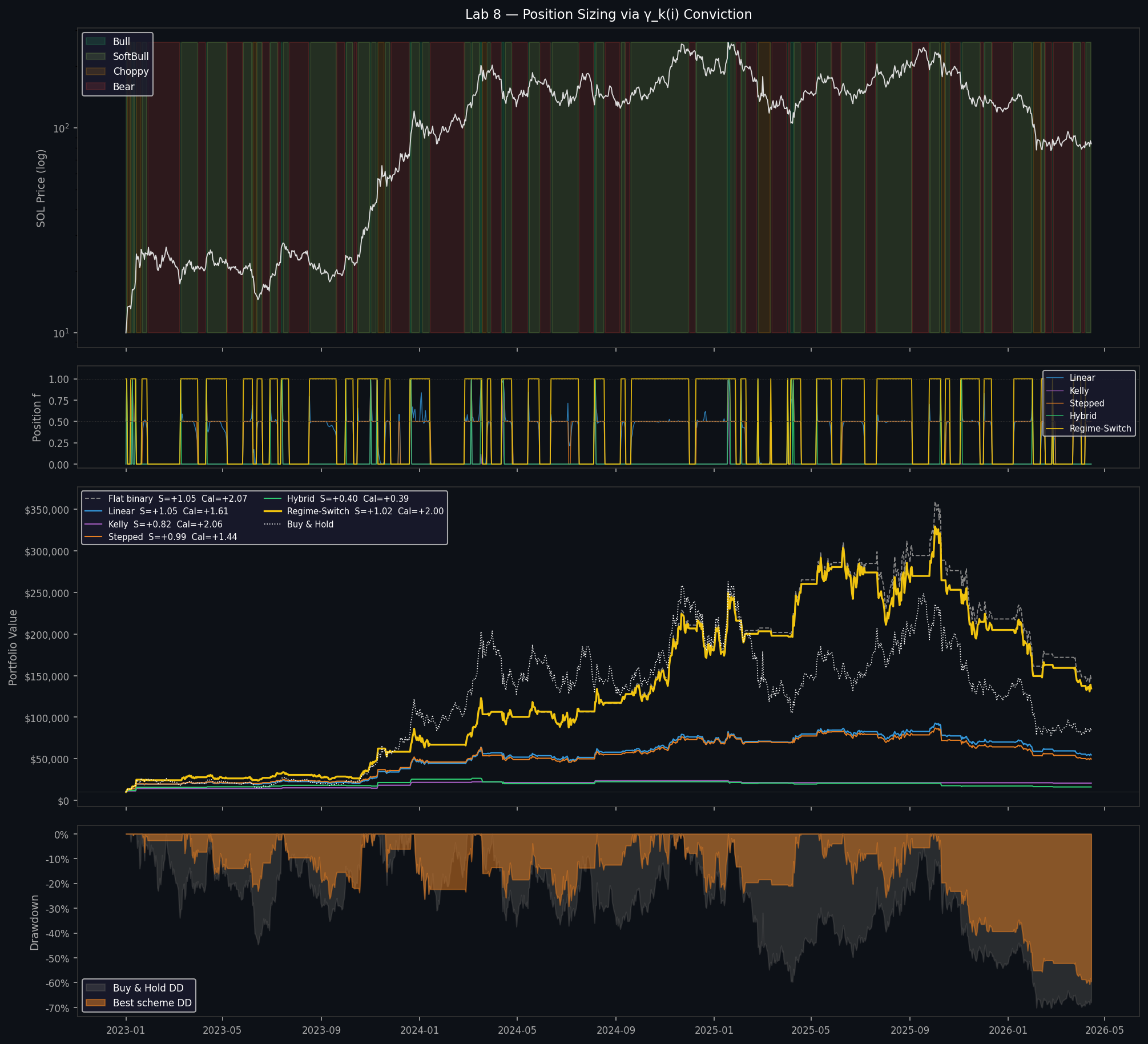
Key Finding#
Flat binary wins on trending SOL. When an asset is in a sustained uptrend, full conviction is the correct bet — fractional sizing just leaves money on the table.
Kelly dominates on capital preservation. Max drawdown drops from 60.7% to 12.0%. For risk-constrained operators, Kelly is the right choice even at lower CAGR.
The regime-switch scheme (low entropy → flat, high entropy → Kelly) nearly matches flat binary — a useful middle ground for mixed market conditions.
Next: Lab 9A#
The sizing schemes above treat all Bull signals equally. Lab 9A asks: can we measure how strong a signal is, beyond the HMM posterior?