Problem#
The Lab 4 HMM was trained on BTC data. When applied to SOL, it labelled 78% of all bars as Choppy — clearly wrong. SOL is a higher-volatility asset with different regime dynamics.
Fix#
Two changes to the HMM for SOL:
- SOL-specific training — refit the HMM on SOL-USD data with a rolling training window
- Volatility ratio feature — add
vol / vol_maas an observation feature to distinguish Choppy from genuine trending states
Results#
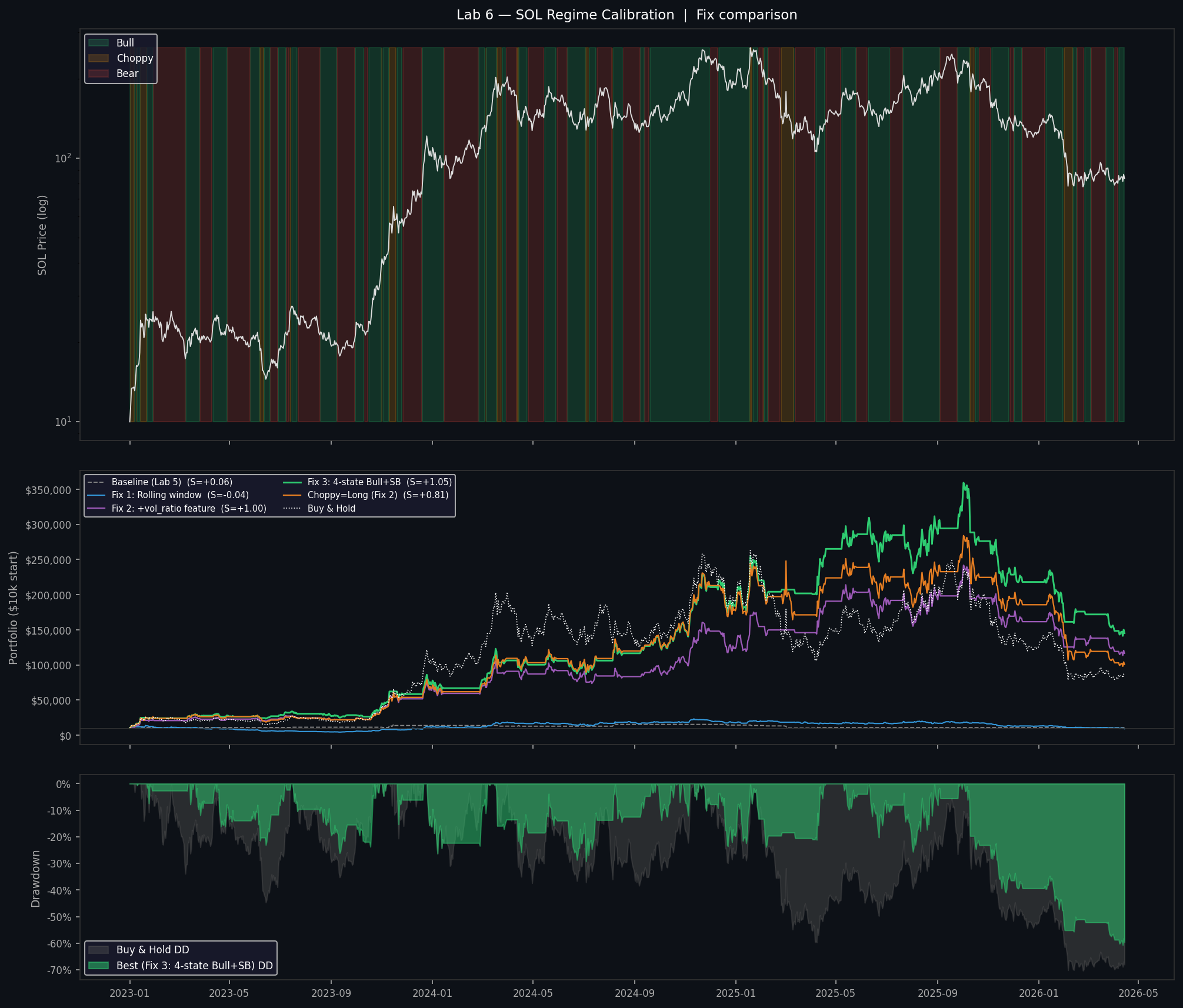
After calibration, the regime distribution across SOL history is realistic:
- Bull and SoftBull states correctly capture 2021 and 2023–2024 uptrends
- Bear states correctly identify 2022 and the FTX crash period
- Choppy is now a minority label, not the default
Key Insight#
A model trained on one asset should not be directly applied to another. The HMM’s emission distributions (mean and variance of candle features) are asset-specific. SOL’s volatility is roughly 2–3× BTC’s — the same Gaussian parameters produce completely different posterior distributions.
The fix: treat the HMM as a per-asset model. The architecture is shared; the parameters are not.