Download: Lab 4 Report PDF
Objective#
Build a regime detector from first principles using Baum’s Hidden Markov Model. The output is not a hard label — it’s a probability distribution over states at every bar. These soft posteriors γ_k(i) feed directly into the position sizing in Lab 8.
Model Architecture#
- States: 3 — Bull, Choppy, Bear
- Observations: Scale-invariant candle shape features:
fracChange,fracHigh,fracLow+ rolling volatility - Algorithm: Baum-Welch EM (10 random restarts, best log-likelihood chosen)
- Output: γ_k(i) — posterior probability of being in state k at time i
The key insight: hard regime labels throw away information. A day that is 70% Bull and 30% Choppy is structurally different from a day that is 99% Bull. The soft posteriors carry that distinction.
States are labelled automatically by mean return — no manual tuning: highest avg return → Bull, lowest → Bear, middle → Choppy.
Results#
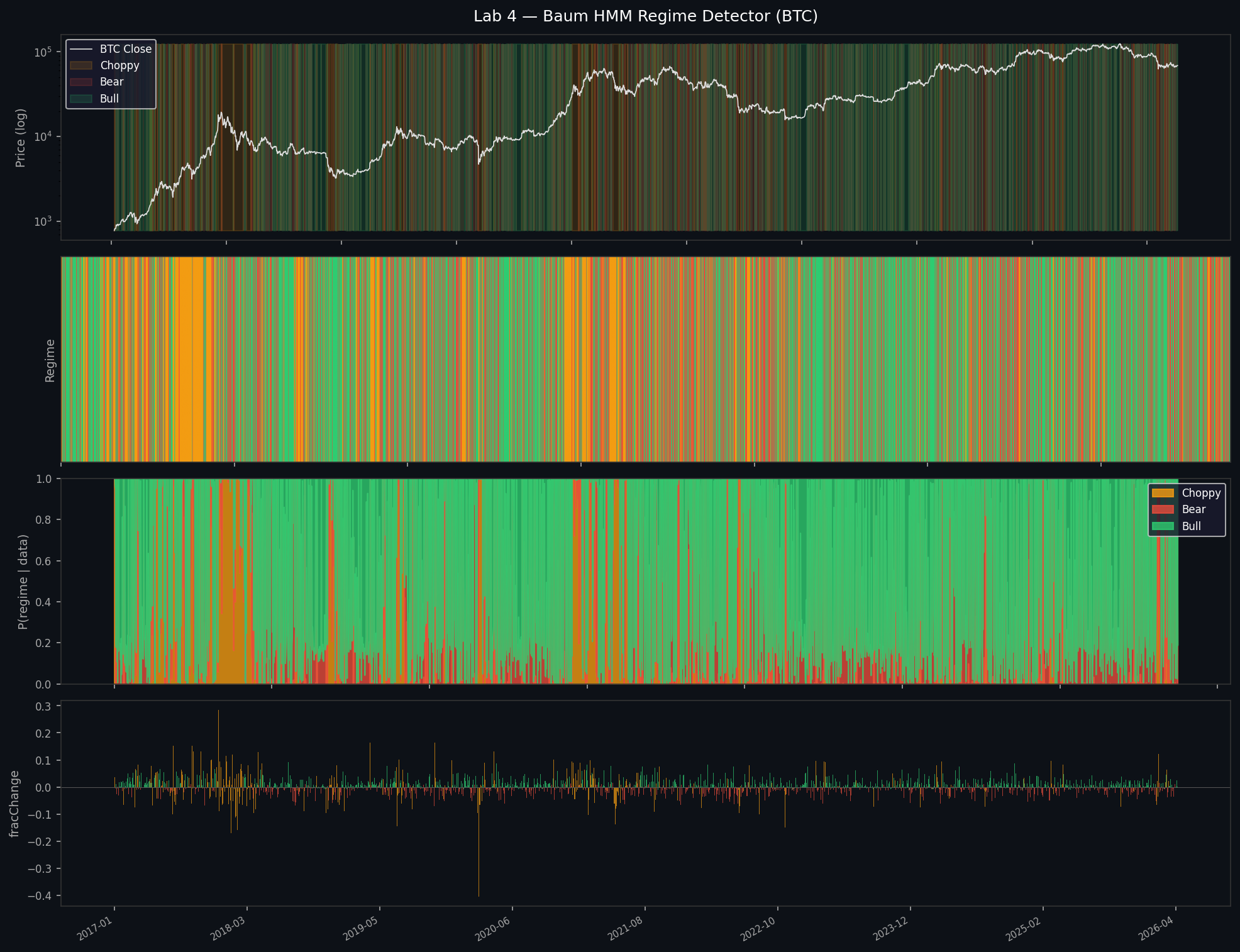
The 4-state HMM correctly identifies:
- Bull regimes during sustained uptrends (2020–2021, 2024)
- Bear regimes around the 2022 crash and 2018 correction
- Choppy/SoftBull during sideways consolidation periods
Connection to Baum’s Math#
Baum (1970) independently discovered the same forward-backward recurrence that appears in Kolmogorov’s equations, Bluman’s symmetry methods, and modern deep learning backpropagation. The HMM is a concrete implementation of a universal mathematical structure.
The γ_k(i) posteriors are the foundation of all subsequent Labs (5, 6, 7, 8, 9).